Choosing the right Autonomous Warehouse solution is not simply a technology purchase. It is an operational decision involving inventory accuracy, labor conditions, safety, software, and future growth. A system that looks impressive in a showroom may struggle with dusty floors, irregular cartons, seasonal peaks, or narrow aisles. Real warehouses are less predictable.
Ken Goldberg, a respected roboticist and professor at the University of California, Berkeley, has stated, “The goal is not to replace people, but to augment their capabilities.” This principle provides a useful starting point. The best Autonomous Warehouse does not merely add robots. It helps workers move faster, reduce repetitive lifting, and make better decisions with reliable data. A picker should see clear task instructions, not fight a confusing interface. A supervisor should track orders, exceptions, battery levels, and maintenance from one practical dashboard.
Begin with the workflow. Measure order profiles, storage density, travel distance, peak volume, and error rates. Then examine integration with the warehouse management system, enterprise software, conveyors, scanners, and safety controls. Ask how the solution performs during outages and sudden demand changes. Ask who maintains it at 2 a.m.
There is no perfect automation model. That matters. Some businesses may need mobile robots, while others benefit from automated storage and retrieval systems, robotic picking, or a hybrid design. Pilot testing can reveal uncomfortable truths before a large investment. The strongest choice balances measurable productivity with worker usability, dependable support, and realistic long-term costs.
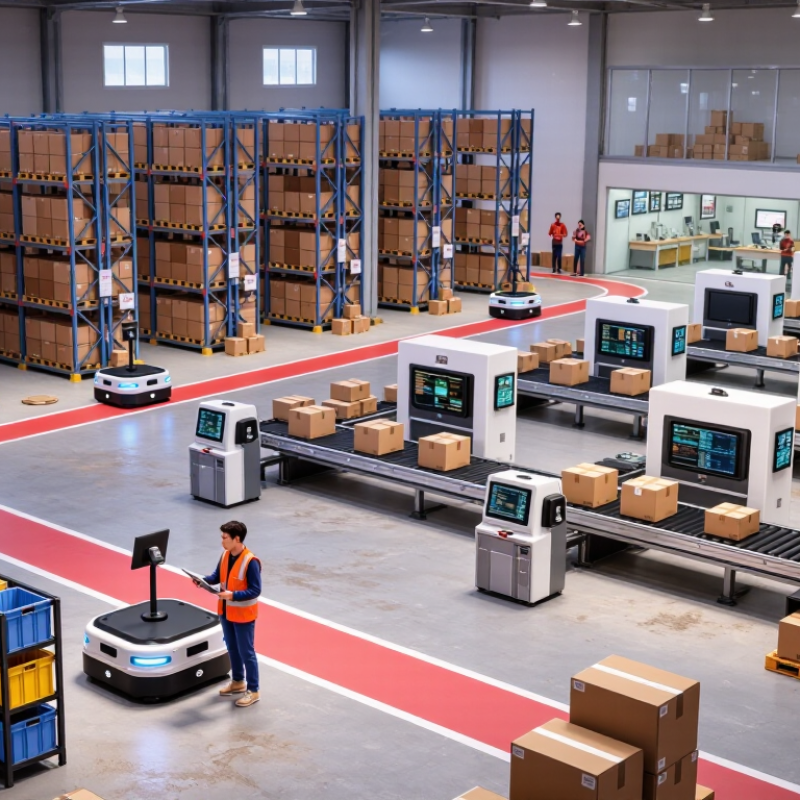
Define the core goals before comparing autonomous warehouse solutions. Start with the operational problem, not the machinery. Measure order lines per hour, peak volume, travel distance, storage density, and picking errors. A useful goal might be “ship 1,200 lines hourly with 99.5% accuracy,” not “install robots.” Include replenishment delays, labor ergonomics, safety events, and seasonal demand. These details show where autonomy can create measurable value.
Industry data supports careful planning. The International Federation of Robotics reported more than 113,000 logistics service robots installed worldwide in 2023, representing a 35% annual increase. This growth shows strong interest, but adoption alone does not prove suitability. The MHI 2024 Annual Industry Report also identifies automation and robotics as major investment priorities across supply chains. Still, a crowded warehouse may need better inventory data first. That part is easy to overlook.
Translate each goal into selection criteria. Check system interoperability, navigation accuracy, uptime, maintenance access, exception handling, and data visibility. Ask whether the solution can manage mixed cartons, damaged labels, blocked aisles, and sudden order peaks. Test with real products and real operators. A clean demonstration is not enough. The first target may be too ambitious, or the payback period may be longer than expected. That is useful information. A controlled pilot can expose these weaknesses before full deployment, while total-cost analysis should include software, integration, training, energy, service, and future expansion.
How to Choose the Best Autonomous Warehouse Solution?
A reliable automation decision starts with observing real warehouse work. Walk the aisles during receiving, picking, replenishment, and late shifts. Record travel distances, waiting time, damaged goods, and manual exceptions. A clean process map often reveals problems that dashboards miss. I have seen teams automate inefficient routes instead of fixing them.
Study the data before comparing equipment. Check inventory accuracy, order profiles, peak volumes, barcode quality, and location records. Historical averages can mislead you. Seasonal spikes may expose capacity limits. Ask whether your warehouse system provides stable interfaces and timely status updates. Missing data creates unreliable decisions, even when the machines perform well. Small errors matter.
Infrastructure also deserves a physical inspection. Measure wireless coverage near metal racks and loading doors. Review floor conditions, lighting, charging areas, network resilience, and emergency access. Confirm that people and autonomous equipment can share space safely. A controlled pilot should test ordinary orders and awkward exceptions. Include blocked aisles, empty locations, urgent picks, and damaged cartons. Measure throughput, error rates, uptime, labor impact, and recovery time. Do not trust one impressive demonstration.
Our first test might still be too narrow. Revisit the assumptions before expanding.
Choosing an autonomous warehouse solution requires more than counting robots. Compare the technology, then test the operating conditions. Autonomous mobile robots follow mapped routes, while vision-guided systems react to changing obstacles. Goods-to-person units optimize repetitive picks. Robotic arms add reach, but require accurate presentation. Each capability solves a different bottleneck. A polished demonstration is not proof.
MHI’s 2024 Annual Industry Report found that 55% of supply-chain leaders planned to increase technology investment. That figure signals urgency, not automatic suitability. Ask for sustained throughput, not a short peak. Request data from facilities with similar SKU variety, aisle width, shift patterns, and order profiles. Evidence matters. Site visits reveal problems that brochures often hide.
Compare capabilities through measurable tests. Record picks per hour, travel distance, error rate, recovery time, and labor changes. Check whether the orchestration layer connects with warehouse-management systems through documented interfaces. Evaluate fleet behavior during congestion. What happens when a robot loses localization? Can operators isolate one zone without stopping the whole site? IFR’s World Robotics 2024 report recorded 541,302 industrial robot installations in 2023. That figure shows strong automation momentum, but not guaranteed warehouse performance. Integration and maintenance still decide results. I would also score training time and spare-part access. These details look minor until a night shift waits. No solution is perfect. The better choice is the one whose weaknesses are visible, measured, and manageable.
Choosing an autonomous warehouse solution starts with integration, not moving robots. Check whether it connects cleanly with your WMS, ERP, scanners, conveyors, and existing safety controls. MHI’s 2024 Annual Industry Report found that 55% of respondents planned to increase supply-chain technology investment. That investment needs measurable value. Ask for live interface tests, error logs, and recovery procedures before signing a contract. A polished demonstration can hide difficult data problems.
Safety requires more than obstacle detection. Review risk assessments, emergency stops, speed limits, pedestrian routes, and maintenance access. Use recognized guidance, including ISO 3691-4:2023 for driverless industrial trucks. Train supervisors and operators with realistic aisle scenarios. Small details matter. A blocked charging station can disrupt an entire shift. The International Federation of Robotics reported 541,302 industrial robots were installed globally in 2023, showing wider automation growth, but warehouse conditions remain different. Do not transfer factory assumptions without testing them.
Scalability should be proven through staged deployment. Measure throughput, pick accuracy, uptime, battery performance, and labor impact during peak periods. Support also deserves evidence. Require response-time commitments, local technical coverage, spare-parts plans, cybersecurity updates, and accessible training. Some solutions scale in software but struggle with floor space, network capacity, or exception handling. That weakness is easy to underestimate. A useful pilot should include failed scans, mixed pallets, manual overrides, and seasonal volume changes. Perfect data rarely exists. Your evaluation should admit that. A solution that explains its limits may be more trustworthy than one promising effortless automation.
| Evaluation Area | Data Dimension | Practical Benchmark or Target | Integration | Warehouse Management System connectivity | High priority Standard API, REST API, webhooks, or middleware support with documented interface specifications. |
API documentation, sandbox access, data-flow diagrams, integration timeline, and a list of supported warehouse-management functions. |
|---|---|---|---|---|---|---|
| Integration | Enterprise-system compatibility | Ability to exchange orders, inventory status, task assignments, and completion events with ERP, WMS, WES, and warehouse-control systems. | Completed integration projects using comparable system architectures and a clearly defined responsibility matrix. | |||
| Integration | Deployment and commissioning time | Pilot deployment planned in phases, with measurable acceptance criteria and rollback procedures. | Implementation schedule, site-readiness checklist, test scripts, user-training plan, and go-live support model. | |||
| Integration | Data and cybersecurity controls | Mandatory Role-based access, encrypted communication, audit logs, backup procedures, and defined software-update controls. |
Security architecture, access-control policy, vulnerability-management process, incident-response procedure, and independent security certifications where applicable. | |||
| Safety | Risk assessment and compliance | Mandatory Documented risk assessment and conformity with applicable machinery, electrical, workplace, and local safety requirements. |
Safety validation documents, technical file, operating instructions, conformity declarations, and records of third-party testing where required. | |||
| Safety | Human–robot interaction | Automatic speed reduction, controlled stopping, obstacle detection, audible or visual warnings, and clearly marked pedestrian zones. | Safety-function descriptions, sensor coverage maps, stopping-distance tests, and demonstrations using representative traffic conditions. | |||
| Safety | Operational reliability | Track mean time between failures, mean time to repair, emergency stops, navigation faults, and task exceptions during the pilot. | Anonymized performance logs, failure-classification method, preventive-maintenance plan, and defined reliability targets. | |||
| Safety | Battery and charging safety | Automated charging with thermal monitoring, overcurrent protection, battery-health alerts, and a documented battery-replacement procedure. | Battery specifications, charging-cycle data, thermal-protection details, fire-prevention measures, and maintenance requirements. | |||
| Scalability | Throughput capacity | Capacity should be validated against peak hourly demand, travel distance, pick density, order profile, and required service level—not only average throughput. | Site-specific simulation, stress-test results, peak-period assumptions, queue analysis, and measured performance under mixed workloads. | |||
| Scalability | Fleet expansion | Preferred Additional robots or workstations can be added without replacing the core control platform or causing extended production downtime. |
Expansion architecture, fleet-management limits, commissioning procedure, software licensing model, and examples of phased deployment. | |||
| Scalability | Layout and product flexibility | Support for changes in storage locations, product dimensions, SKU volume, aisle configuration, and seasonal demand. | Digital-twin or simulation capability, change-management process, reconfiguration time, and restrictions on load size or packaging. | |||
| Scalability | Availability and maintainability | Define target system availability, planned maintenance windows, spare-parts lead times, and recovery procedures before contract approval. | Service-level agreement, maintenance calendar, spare-parts inventory policy, remote-diagnostics capabilities, and disaster-recovery plan. | |||
| Support | Technical support response | Contractual requirement Severity-based response and restoration times, including an escalation path for production-critical incidents. |
Service-level agreement with response targets, support hours, escalation contacts, ticketing workflow, and regional coverage. | |||
| Support | Training and operational handover | Role-based training for operators, supervisors, maintenance staff, IT teams, and safety personnel before go-live. | Training curriculum, competency checks, operating manuals, maintenance guides, and refresher-training schedule. | |||
| Support | Software lifecycle and updates | Documented release schedule, backward-compatibility policy, test environment, change-notification process, and update rollback capability. | Software-maintenance policy, release notes, support-period commitments, update-testing procedure, and end-of-life policy. | |||
| Support | Total cost of ownership | Evaluate capital cost, integration, infrastructure, energy, consumables, labor impact, maintenance, software fees, and replacement parts over the planned operating period. | Five-year or seven-year cost model, assumptions register, implementation costs, recurring fees, energy estimates, and sensitivity analysis. | |||
| Decision | Pilot success criteria | Recommended Use measurable targets for throughput, task accuracy, safety incidents, system availability, integration defects, and operator acceptance. |
Signed pilot protocol, baseline operating data, acceptance-test results, corrective-action log, and a scale-up decision gate. | |||
| Note: Benchmarks are evaluation guidelines rather than universal guarantees. Final targets should be validated through a site-specific feasibility study, risk assessment, simulation, and controlled pilot. | ||||||
Choosing an autonomous warehouse solution starts with total cost, not the purchase price. MHI’s 2024 Annual Industry Report found that 55% of supply chain leaders planned to increase technology investment. That pressure can encourage rushed decisions. It can also hide operational weaknesses. Walk through the facility and record travel distances, queue times, shift patterns, and manual touches. These details reveal costs that a sales proposal may overlook.
Build a five-year total cost model. Include equipment, software, integration, site preparation, training, maintenance, spare parts, charging, cybersecurity, and downtime. Add labor savings only after measuring actual tasks. The cheapest quote misleads. Compare cost per completed order, not cost per vehicle. Test different volumes, peak seasons, wage changes, and battery replacement dates. Our first model may be wrong. That is useful. Review every assumption with warehouse supervisors and finance teams.
The International Federation of Robotics reported more than 100,000 professional service robots for transportation and logistics in 2023. Growing adoption does not guarantee fit. Ask whether the system handles your aisle width, floor quality, payload mix, and exception rate. Run a controlled pilot with real products and difficult orders. Measure throughput, availability, picking accuracy, recovery time, and worker acceptance. A solution that performs well only during a quiet shift is not reliable. Select the option with transparent data, maintainable processes, and a defensible five-year cost.
Five-year total cost of ownership comparison for a 10,000 m² warehouse processing approximately 5,000 order lines per day.
The comparison includes equipment, software and integration, installation, maintenance, energy, and labor over five years. A solution with a higher initial investment can deliver a lower total cost when it reduces manual handling and scales efficiently with order volume.
Define measurable goals, such as shipping 1,200 lines hourly with 99.5% accuracy. Start with evidence. Include peak volume, travel distance, storage density, errors, safety, and replenishment delays.
Automation can repeat inefficient routes instead of fixing them. Walk receiving, picking, replenishment, and late-shift activities. Record waiting time, damaged goods, manual exceptions, and aisle travel.
Review inventory accuracy, order profiles, peak volumes, barcode quality, and location records. Historical averages can hide seasonal capacity problems. Small errors matter.
Inspect wireless coverage near metal racks and loading doors. Check floor conditions, lighting, charging spaces, network resilience, and emergency access. A blocked charging area can interrupt an entire shift.
Connect the proposed system with warehouse software, enterprise systems, scanners, conveyors, and safety controls. Request live interface tests, error logs, and recovery procedures. A polished demonstration is not enough.
Test ordinary orders and difficult exceptions, including blocked aisles, failed scans, empty locations, and damaged cartons. Measure throughput, accuracy, uptime, recovery time, and labor impact. The first test may be too narrow.
Review emergency stops, speed limits, pedestrian routes, maintenance access, and risk assessments. Train operators using realistic aisle scenarios. People and autonomous equipment must share space safely.
Ask about response times, local technical help, spare parts, cybersecurity updates, training, and future expansion. Test peak demand, battery performance, mixed pallets, and manual overrides. Perfect data rarely exists.
Choosing the best Autonomous Warehouse solution begins with clearly defining the operational goals, such as improving throughput, reducing errors, increasing storage efficiency, or supporting safer working conditions. Organizations should then review current warehouse processes, data quality, facility layout, equipment, and network infrastructure to determine whether the environment can support automation effectively. A realistic assessment helps identify limitations and prevents selecting technology that does not match daily operating requirements.
Next, compare autonomous technologies by examining navigation, material handling, task coordination, adaptability, and system intelligence. The evaluation should also cover software integration, worker safety, cybersecurity, scalability, maintenance, training, and long-term technical support. Finally, calculate the total cost of ownership, including installation, integration, energy use, maintenance, upgrades, and potential productivity gains. The best solution is not necessarily the most advanced or expensive option, but the one that aligns with business objectives, existing infrastructure, future growth plans, workforce needs, and measurable return on investment.

SCP