How to Choose an Automated Guided Vehicle in Singapore?

Time:2026-10-18 Author:Sienna
0%

Choosing an Automated Guided Vehicle in Singapore requires more than comparing payloads, prices, and battery types. The right system must fit your facility, workers, traffic patterns, and future growth. A vehicle that performs well in a wide European warehouse may struggle beside Singapore’s compact aisles, humid loading bays, or mixed pedestrian routes.

Start with the movement itself. Measure travel distances, floor conditions, turning space, loading heights, and hourly delivery peaks. Watch the real workflow. A quiet warehouse map can hide frequent stops, blocked lanes, or manual handovers. These details affect whether you need magnetic guidance, laser navigation, QR markers, or autonomous mobile features.

“Automation should amplify human capability, not simply replace it,” says robotics researcher Dr. Daniela Rus. This principle matters when evaluating an Automated Guided Vehicle Singapore solution. The strongest choice supports safer lifting, steadier replenishment, and clearer task allocation. It should also connect reliably with warehouse management software and existing doors, lifts, and charging areas.

Do not ignore maintenance. Ask how quickly technicians respond, where spare parts are stored, and how software updates are controlled. Request a live site trial, not only a polished demonstration. Test narrow turns. Test peak traffic. Test failure recovery.

There is no perfect vehicle. Even experienced teams can underestimate integration effort, charging downtime, or operator training. A careful selection process accepts those uncertainties, records them, and measures performance before making a full investment.
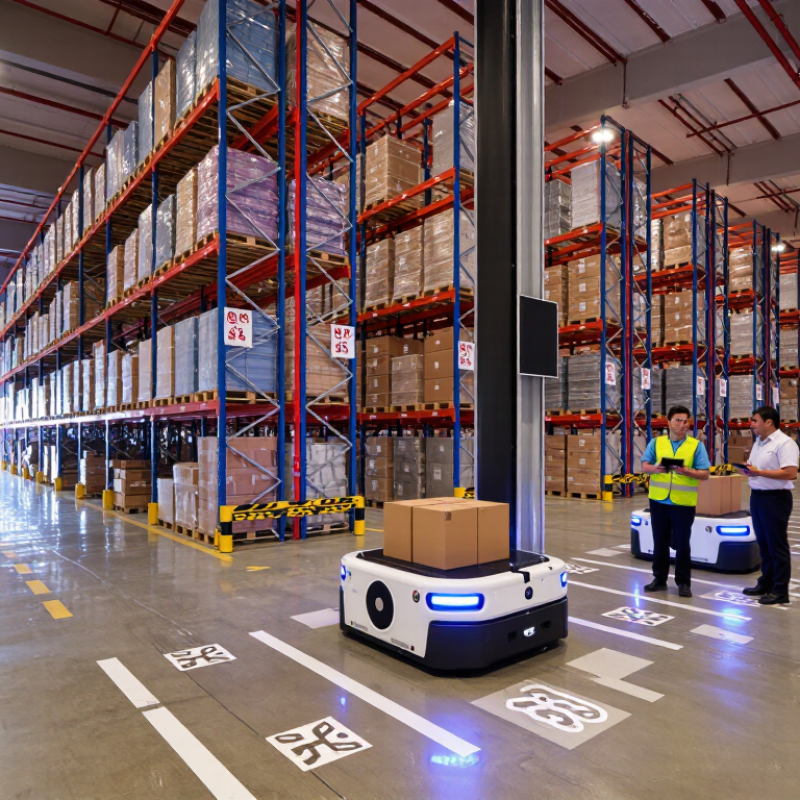
How to Choose an Automated Guided Vehicle in Singapore?

What Is an Automated Guided Vehicle and How Does It Work?

An automated guided vehicle (AGV) is a mobile machine that moves materials without direct driving. It transports pallets, cartons, or components between fixed locations. Unlike manually driven forklifts, an AGV follows programmed routes and control instructions. Most AGVs use magnetic tape, laser maps, reflectors, or floor markers. Some systems combine cameras and sensors to detect people, obstacles, and unexpected changes.

A central controller sends movement tasks to the vehicle. The AGV reads its route, adjusts speed, and stops when its safety scanner detects an obstruction. At a loading point, it can lift a pallet, carry it, and place it at a designated station. In a Singapore warehouse, this process may connect with inventory software and automatic doors. Clear communication between these systems matters. A small data error can delay several tasks.

Choosing an AGV requires a practical site survey. Check aisle widths, floor conditions, turning space, traffic patterns, and loading heights. Humidity, heat, and frequent cleaning can also affect sensors and battery performance. Select a guidance method that suits the building, not merely the newest option. Operators should test emergency stops, manual recovery, and route changes before daily use. A limited pilot can reveal hidden problems. No system is perfect. Dust, blocked routes, or inaccurate maps may still interrupt work. Training remains essential, even when automation appears simple.

Which AGV Types Suit Different Singaporean Operations?

How to Choose an Automated Guided Vehicle in Singapore?

Which AGV Types Suit Different Singaporean Operations?

Choosing an AGV starts with the movement pattern, not the vehicle’s appearance. Tugger AGVs suit factories moving several carts between loading bays and production lines. Pallet AGVs work well in warehouses with repeated pallet transfers and predictable routes. Forklift AGVs support storage and retrieval, but they need accurate floor markings and carefully controlled pedestrian zones.

Unit-load AGVs fit distribution centres handling cartons, totes, or small containers. In compact Singapore facilities, their smaller turning radius can protect valuable floor space. Hospitals may use tray or cart vehicles for scheduled internal deliveries. Cold-storage sites require batteries, sensors, and materials rated for low temperatures. An autonomous mobile robot may be better when routes change often, although it usually needs stronger traffic-management software.

Tips: Measure aisle width, floor condition, load weight, travel distance, and peak traffic first. Test the vehicle during busy shifts. A quiet trial can mislead. Check charging locations, emergency stops, maintenance access, and staff training. Singapore’s heat, humidity, tight layouts, and mixed pedestrian traffic deserve practical testing. Confirm risk assessments and workplace-safety requirements before deployment. A neat digital map may still fail beside a wet floor, a temporary rack, or an opened fire door. Review those uncomfortable details early.

How to Assess Facility Needs Before Selecting an AGV

How to Choose an Automated Guided Vehicle in Singapore?

Before selecting an AGV, study the facility as it operates today. Map every route from receiving docks to storage, picking, packing, and dispatch. Record travel distances, floor conditions, doorway widths, lift access, and pedestrian crossings. In Singapore, compact facilities often hide difficult turning points. A drawing may miss them.

The International Federation of Robotics reported 541,302 industrial robots installed globally in 2023. Its 2024 service robotics report also recorded more than 113,000 professional transportation and logistics robots sold that year.

These figures show strong momentum, not automatic suitability. Measure the actual load first. Include pallet dimensions, weight variation, centre of gravity, and loading frequency. Then calculate peak-hour traffic, not only daily averages. An AGV that works at 2 p.m. may struggle during evening dispatch.

Safety needs evidence. Review pedestrian density, emergency exits, fire equipment, and charging locations. Check floor flatness and signal coverage across steel racks and cold areas. The MHI Annual Industry Report 2024 identifies robotics and automation as major supply-chain investment priorities. Still, adoption does not remove integration risk. Run a controlled pilot with real operators and imperfect demand data. Observe blocked aisles, late pallets, and manual workarounds. Those details matter. One overlooked exception can weaken the entire return-on-investment calculation.

What Technical and Safety Features Should You Compare?

Choosing an automated guided vehicle in Singapore requires more than comparing payload and price. Start with the route. Measure aisle width, turning space, floor joints, ramps, dock plates, and pedestrian crossings. A vehicle carrying 500 kilograms may fail if its turning radius blocks a 2.2-metre aisle. Check localization accuracy, stopping distance, lift height, battery runtime, charging method, and recovery after Wi-Fi loss. Singapore’s heat and humidity also deserve testing, especially near loading bays.

Safety features should match real traffic, not a showroom diagram. Compare 360-degree obstacle detection, safety laser scanners, audible warnings, emergency stops, reduced-speed zones, and safe braking under maximum load. ISO 3691-4:2020 provides safety requirements for driverless industrial trucks. Ask suppliers for test records against this standard, not only compliance statements. Singapore’s Ministry of Manpower recorded 36 workplace fatalities in its 2023 Workplace Safety and Health Report, reminding buyers that automation still operates around people. Small gaps matter.

Fleet software needs equal attention. Review traffic control, map editing, access permissions, event logs, cybersecurity updates, and manual recovery procedures. The International Federation of Robotics reported 541,302 industrial robots installed worldwide in 2023, showing rapid automation growth, but industrial robots and AGVs have different risks. A polished dashboard can still hide weak integration. Run a paid site trial during peak shifts. Test blocked aisles, reflective wrapping, wet floors, low battery alarms, and a failed network connection. The first specification is rarely perfect. That is useful.

How to Choose an Automated Guided Vehicle in Singapore?

Suggested comparison weighting for technical and safety evaluation

When comparing AGVs in Singapore, safety should be assessed alongside navigation, payload capability, system integration, cybersecurity and service support. The weighting below is a practical screening model, not a supplier ranking. Confirm the final selection against the current requirements of ISO 3691-4 for driverless industrial trucks, ISO 13849-1 for safety-related control systems, IEC 62443 principles for industrial cybersecurity, and applicable Singapore workplace-safety requirements.

How to Evaluate AGV Costs, Support, and Local Compliance?

Choosing an Automated Guided Vehicle in Singapore requires more than comparing purchase prices. The International Federation of Robotics reported 541,302 industrial robot installations worldwide in 2023. This signals strong automation demand, but AGV performance still depends on site conditions. Measure aisle width, floor quality, pedestrian traffic, loading points, and daily travel distance. Small obstacles can create expensive delays.

Evaluate the full cost over five years. Include vehicles, batteries, chargers, software, integration, training, maintenance, spare parts, and downtime. A simple payback spreadsheet may mislead. Request service response times, local technicians, spare-parts availability, and remote-support procedures. Ask for performance data from similar temperature, load, and shift conditions. Lower prices can hide weak after-sales support. That matters.

Singapore compliance also needs early attention. The Ministry of Manpower requires workplace risk assessments under the Workplace Safety and Health framework. ISO 3691-4:2020 provides safety requirements for driverless industrial trucks, including protective systems and operating controls. Check emergency stops, warning signals, speed limits, pedestrian separation, and safe charging areas. Keep test records and operator training evidence. A corridor that looks safe during a quiet demonstration may become risky during peak operations. Recheck the design after installation. Mistakes often appear then.

How to Choose an Automated Guided Vehicle in Singapore? - How to Evaluate AGV Costs, Support, and Local Compliance?
A practical comparison framework for evaluating AGV solutions by payload, navigation, total cost, service support, site conditions, safety, and Singapore compliance requirements.
Evaluation Dimension Typical Singapore Requirement or Benchmark What to Check Before Purchase Recommended Decision Guidance
Application and Load Type Suitable applications include pallet movement, line-side delivery, tote transport, tugger trains, and repetitive warehouse routes. Typical payload classes range from approximately 300 kg to more than 2,000 kg. Confirm load dimensions, centre of gravity, pallet condition, transfer height, loading method, turning radius, and whether the vehicle must tow trailers. Select the smallest vehicle that safely handles the maximum operating load. Include a safety margin for uneven loading and future product changes.
Navigation Technology Common options include magnetic tape, laser-based navigation, natural-feature navigation, QR or reflector guidance, and hybrid navigation. Review floor markings, lighting, dust, reflective surfaces, route changes, pedestrian traffic, rack density, and required navigation accuracy. Use flexible natural-feature or hybrid navigation where routes are likely to change. Fixed guidance may be economical for stable, repetitive routes.
Vehicle Performance Typical operating speeds are approximately 0.8–1.5 m/s in mixed pedestrian areas. Higher speeds may be possible in controlled zones subject to risk assessment. Measure route length, stops per cycle, loading and unloading time, intersection delays, floor gradients, doorways, lift access, and traffic restrictions. Compare completed moves per hour rather than maximum speed alone. A slower vehicle with fewer interruptions may deliver higher throughput.
Battery and Charging Lithium-ion batteries commonly support opportunity charging and may reduce battery-handling requirements. Lead-acid systems generally require longer charging periods and controlled charging areas. Check operating hours, charging windows, battery replacement method, charging-room ventilation, fire controls, electrical load, and compatibility with the facility power supply. Choose opportunity charging for multi-shift operations when the route and duty cycle allow regular charging pauses. Validate battery life using the actual workload profile.
Indicative Capital Cost A single standard AGV may commonly fall within approximately SGD 60,000–180,000, excluding GST, depending on payload, navigation, safety equipment, and software. Request a cost breakdown covering the vehicle, batteries, chargers, fleet software, installation, mapping, integration, training, testing, and commissioning. Do not compare vehicle prices alone. Evaluate the complete project cost and the number of vehicles required to meet the target throughput.
Integration and Software Integration may involve warehouse management systems, manufacturing execution systems, warehouse control systems, elevators, automatic doors, conveyors, and production equipment. Confirm available communication interfaces, API documentation, task-allocation logic, traffic management, cybersecurity controls, user permissions, alarms, and reporting functions. Prefer open interfaces and documented data ownership. Require a tested interface specification before committing to full deployment.
Local Service and Support For operations in Singapore, practical support usually includes local or regional response, remote diagnostics, spare-parts availability, preventive maintenance, and operator training. Ask for guaranteed response times, escalation procedures, local technician coverage, spare-parts lead times, software-support terms, and service availability during production hours. For critical production or 24-hour operations, require a documented service-level agreement and locally available critical spare parts.
Safety and Risk Assessment Safety design should address collision prevention, emergency stops, speed limitation, obstacle detection, audible or visual warnings, safe stopping distances, and pedestrian interaction. Request a risk assessment based on ISO 12100 principles, safety-related control information aligned with ISO 13849-1 where applicable, and evidence of testing for the intended operating environment. Separate pedestrians and vehicles where possible. Use physical barriers, controlled crossings, warning zones, and speed restrictions instead of relying only on sensors.
Singapore Compliance Review applicable requirements under Singapore’s Workplace Safety and Health framework, machinery-safety obligations, electrical-safety rules, and relevant international standards such as ISO 3691-4:2020 for driverless industrial trucks. Confirm equipment documentation, declaration of conformity, safety validation, electrical ratings, emergency procedures, maintenance instructions, and site-specific risk controls. Obtain a formal compliance review from a competent safety professional before operation. Compliance responsibility may involve the equipment supplier, integrator, employer, and site owner.
Site and Environmental Conditions Singapore facilities may experience high humidity, air-conditioning transitions, narrow aisles, frequent pedestrian movement, and mixed-use warehouse or production areas. Verify floor flatness, floor load capacity, gradients, expansion joints, ambient temperature, humidity, dust, water exposure, lighting, drainage, and wireless-network coverage. Conduct a site survey before final specification. Confirm that the navigation and safety systems remain reliable under the actual environmental conditions.
Implementation Timeline A straightforward pilot may take approximately 8–16 weeks after specification approval. Larger deployments involving multiple systems may require several additional months. Define the scope of simulation, site preparation, software integration, factory acceptance testing, site acceptance testing, operator training, and production ramp-up. Start with a controlled pilot route and measurable acceptance criteria before expanding to additional zones or shifts.
Total Cost of Ownership Total ownership cost includes purchase, installation, software, batteries, charging equipment, maintenance, spare parts, training, downtime, energy, and future modifications. Request a 5-year cost model with assumptions for operating hours, battery replacement, preventive maintenance, software fees, service contracts, and expected vehicle availability. Compare solutions using cost per completed move, availability, labour reduction, throughput improvement, and payback period rather than acquisition price alone.
Suggested Selection Weighting Safety and compliance: 25%; throughput and technical fit: 25%; total cost of ownership: 20%; local support: 15%; integration and scalability: 10%; sustainability and energy use: 5%. Adjust the weighting according to the site risk profile, production criticality, labour availability, operating hours, and expected expansion. Reject any solution that fails mandatory safety, compliance, or site-fit requirements, even if its weighted commercial score is attractive.
Cost note: All cost figures are indicative planning ranges in Singapore dollars and exclude GST, site construction, building modifications, and project-specific integration. Final pricing should be confirmed through a site survey, technical specification, and written implementation proposal.

FAQS

What is an automated guided vehicle?

An automated guided vehicle moves pallets, cartons, or components without direct driving. It follows programmed routes between fixed locations. It can lift, carry, and place loads.

How does an automated guided vehicle navigate?

It may use magnetic tape, laser maps, reflectors, floor markers, cameras, or sensors. A central controller assigns movement tasks. The vehicle adjusts speed and stops when it detects an obstacle.

Where can an automated guided vehicle work effectively?

It works well on repeated routes between receiving, storage, picking, packing, and dispatch areas. Clear paths and stable loading points improve performance. A drawing may miss tight turns.

What should a facility measure before selecting one?

Measure aisle widths, floor joints, ramps, doorways, turning areas, and loading heights. Record pedestrian crossings and lift access. Check peak-hour traffic, not only daily averages.

How should the required load capacity be calculated?

Record pallet size, weight variation, load balance, and loading frequency. A vehicle carrying 500 kilograms may still fail in a narrow aisle. Centre of gravity matters.

Which safety features deserve comparison?

Compare obstacle detection, safety scanners, warning signals, emergency stops, reduced-speed zones, and braking distance. Test performance with maximum loads. Small gaps matter.

Can heat, humidity, dust, or wet floors affect operation?

Yes, environmental conditions can affect sensors, batteries, and route accuracy. Test areas near loading bays and cleaning zones. The first specification may be wrong.

Should a facility run a pilot before full deployment?

Yes, use real operators during busy shifts. Test blocked aisles, reflective wrapping, low batteries, wet floors, and network loss. Test it. A limited pilot can reveal hidden manual workarounds.

What software and training are needed?

Fleet software should support traffic control, map editing, event logs, permissions, and manual recovery. It should connect with inventory systems and automatic doors. Training remains essential, even when operation looks simple.

Conclusion

Choosing an Automated Guided Vehicle Singapore requires a clear understanding of how AGVs operate and how they can support different material-handling tasks. These vehicles follow programmed routes, sensors, markers, or navigation systems to transport goods with limited manual intervention. Businesses should compare suitable AGV types, such as units for pallets, carts, towing, or flexible warehouse movement, based on load capacity, travel distance, floor conditions, workflow, and available space.

Before making a decision, facilities should assess traffic patterns, integration needs, operating hours, charging arrangements, and future expansion plans. Important comparisons include navigation accuracy, obstacle detection, emergency stopping, cybersecurity, battery performance, and compatibility with existing systems. Total cost should cover purchase, installation, training, maintenance, downtime, and software updates rather than the initial price alone. Reliable technical support, spare-parts availability, operator training, and compliance with Singapore’s workplace safety and operational requirements are also essential for achieving a safe, efficient, and sustainable AGV deployment.


Sienna

Sienna

Sienna is a skilled marketing professional with a deep expertise in our company’s core products and services. With a passion for innovation and detail, she plays a pivotal role in crafting insightful blog posts that not only highlight the unique features of our offerings but also provide valuable......